WITH A HEART ON THE HILL AND IN THE MINE
30th Meeting of Mining Towns and Municipalities of the Czech republic 19th European Day of Miners and Metallurgists
12 - 14 June 2026 in Příbram
Příbram Mining Museum – Ševčinský Mine
Tour Area A The “Ševčinský Mine” begins with the entrance building of the former ore bins, featuring an exhibition entitled “Traditional Crafts and Industry in the Příbram Region”, and continues with the permanent exhibition “Mining and Metallurgical Structures of the Příbram Region in Historical Photographs”.
Here, visitors can learn about the economic, social and cultural development from the Middle Ages to the 20th century, influenced on the one hand by the dominant mining and metallurgical activities and on the other by traditional crafts (wax-making, woodcarving, nativity scene-making, basket-weaving, ring-making, etc.) and small-scale industry (the production of pilgrimage goods and the like) on the other. These traditional economic activities were directly linked to the existence of the nearby church at Svatá Hora. This architectural gem of the Czech Baroque is one of Europe’s leading pilgrimage sites and is dedicated to the Marian cult, as evidenced by a number of exhibits in the museum’s entrance exhibition.
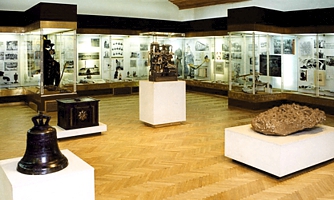
The building known as the ‘miners’ hall ’, dating from 1880, houses the exhibition ‘From the History of Mining in Příbram’, which traces local mining and metallurgical activity from prehistoric times to the end of mining operations in the late 20th century. It documents nearly a thousand years of exploitation of the historic silver ore district as well as the mining of the uranium deposit after 1948. Among the most valuable exhibits are prehistoric evidence of the beginnings of mining activity, bronze objects from the Celtic civilisation, as well as the oldest charter confirming the existence of Příbram from 1216 and the first written document about the local smelter and mines from 1311. All this is complemented by displays of medieval and modern mining tools, miners’ uniforms and the like. There is also information on the famous mining school from 1849, which later became the Mining Academy and the University of Mining.
Also noteworthy are the materials relating to the world’s largest mining disaster at the time, which occurred in 1892 at the Marie shaft. Facts concerning the existence of the Příbram Ore Mines and the Příbram Uranium Mines are also covered . Visitors can see exhibits relating to mining, surveying and rescue technology, as well as samples of silver, lead and uranium ore. In this exhibition, the museum also recalls the infamous chapter in the history of uranium mining associated with the illegal deployment of political prisoners in the uranium mines following the February coup in 1948.
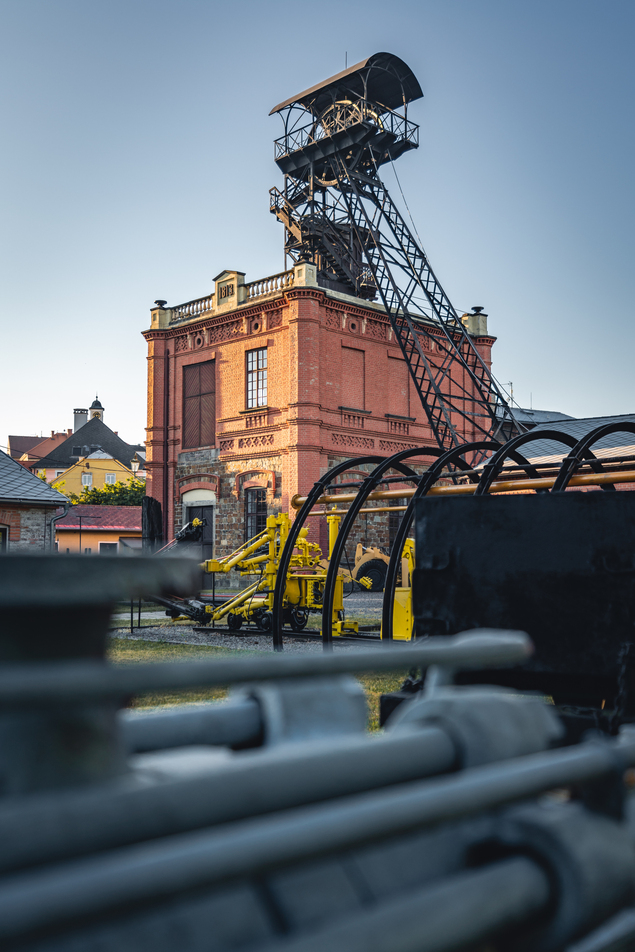
This exhibition is thematically linked to three other permanent exhibitions entitled ‘The Development of Vertical Mine Transport in the Příbram Region’, “Drilling Technology in the Příbram Mines” and “Panorama of the Březohory Ore District” , installed in the attractive, authentic setting of the Ševčinská shaft, where visitors can also see the mouth of the shaft with its hoist cage. The shaft tower itself, dating from 1879 and built in the 19th-century industrial architectural style (Malakov), has been nominated for inclusion on the UNESCO list of industrial heritage sites due to its historical and architectural value . Visitors to this site are also treated to a unique view of the surrounding area from the Ševčinská Tower gallery at a height of 27 metres.
The Ševčinský Mine engine room houses an exhibition entitled “The International Significance of the Březové Hory Ore District and Life in Březové Hory in the 19th Century”, which showcases the most famous period of local mining, when a number of firsts of international significance were achieved in the Příbram region, such as the use of steam hoisting engines, hoisting equipment and wire hoisting ropes for the first time in European ore districts, reaching a depth of 1 km for the first time in the world, and the extraction of more than 90% of the silver and lead reserves within the Habsburg Monarchy, among others. The exhibition offers a wealth of period documents, technical plans and artefacts on this theme, such as a monumental domestically produced mining compressor from 1928, parts of a hoisting machine, examples of drilling equipment and the remains of the oldest mining wagon.
A valuable exhibit located in the engine room of the Ševčinský Mine is a fire engine from the Příbram Mining Directorate dating from 1885, manufactured by F. Smekal, Prague – Smíchov. It was donated to the Příbram Mining Museum in 2006 by Zdeněk Tůma and Václav Máša from Dobříš.
In the former administrative building of the Ševčinská shaft, dating from 1885, the museum has prepared thematically organised exhibition sections featuring valuable mineralogical – geological specimens from the Březohory silver-bearing district, the uranium deposit and the Podbrdy iron-ore region, dominated by a collection of silver minerals.
The highlight is the largest piece of mined silver on display in Czech museums, weighing 11 kg and measuring 35 x 20 x 15 cm, originating from Shaft No. 21, which the museum acquired in 2014 thanks to a contribution from its founder, the Central Bohemian Region. The mineralogical specimens are complemented by examples of old mining tools, tallow and oil lamps, ceremonial miners’ walking sticks known as ‘švancary’, and homemade models of shafts – so-called ‘štufnverky’. Visitors can also view a long-term themed exhibition on the palaeontology of the Příbram region.
This unique exhibition project was created on the spoil heap of the Ševčinská shaft. Mining equipment used in the ore and uranium mines of Příbram in the second half of the 20th century has been installed along more than 180 metres of track. Replicas of a historic mining winch, capstan and bell tower are also on display here . The construction of the open-air museum of mining machinery would not have been possible without the assistance of the former state-owned enterprise Rudné doly Příbram, now DIAMO.
From the courtyard of the Ševčinský Mine, a mining train sets off along a 230-metre route towards the Vojtěch Mine. This unique technical curiosity and attraction for both children and adults is a partial reconstruction of the historic railway that existed here in 1884 and was used to transport silver and lead ore from the Ševčinský Mine site to the Vojtěch processing plant. The train ride, apart from the unusual experience of the mode of transport itself, which transports passengers back to a time over a century ago, also offers unusual views of the beautiful Brdy landscape.
Within Tour Area A, visitors can visit an original 18th-century miner’s cottage. The living room, with its black kitchen and entrance hall, is furnished in the style of a typical miner’s family home at the turn of the 19th and 20th centuries. In the two adjoining rooms, temporary exhibitions related to the lives of mining families are held; there is an exhibition of painted furniture, complemented by drawings and watercolours, depicting the original buildings in Březové Hory and the surrounding villages in the Podbrdsko region at the beginning of the 20th century. The most famous native of the miner’s cottage was RNDr. Zdeněk Pilous, a botanist, conservationist and co-founder of the Krkonoše National Park. Building No. 105 is located on Havířská Street, roughly 300 m from the Ševčinský Mine.
Another option within Tour Area A is a visit to the underground Drkolnov Mine (originally August), which was sunk in 1836. A technical monument of international significance is the enormous water wheel with a diameter of 12.4 metres, which was an integral part of the water management complex (water reservoirs, channels, drainage, supply and waste adits, waterwheel chambers, and the waterwheels themselves). The Drkolnov water wheel was commissioned around 1850 and pumped water from underground using an ingenious water-powered system (prior to the installation of a steam engine) until 1899. In the 1890s, the original wooden wheel was replaced with an iron one. It was then used to pump drinking water for the town of Příbram until 1961. Between 2000 and 2003, the water wheel was secured, reconstructed and preserved, whilst the local underground spaces were also adapted for tourist purposes. The tour also includes a unique attraction for children and adults alike – a ride down a 51-metre-long chute into the mine’s underground chambers (subject to weather conditions).
Fotogalerie
General partners


Main partners








Partners










Media partner

Event organizers